

THACCA: Thailand's Creative Super-Agency in the Making — and What It Signals for ASEAN
Thailand Creative Culture Agency (สำนักงานส่งเสริมวัฒนธรรมสร้างสรรค์) What it is: A planned "super agency" under the Prime Minister to drive Thailand's soft-power and creative-industry strategy across 11 sectors — food, sports, festivals, tourism, music, books, film, games, art, design, and fashion Declared models: Korea's KOCCA, Taiwan's TAICCA, France's CNC Status (June 2026): Operating informally since early 2024 under the Strategic Transformation Office; not yet established as a legal entity, pending passage of its founding act Headline targets: Upskill 20 million Thais through "One Family, One Soft Power" (OFOS); 20 million jobs; 1 trillion baht in annual income |
When Thailand's Pheu Thai-led government took office in September 2023, its very first cabinet meeting created the National Soft Power Strategy Committee — a signal of how central the creative economy had become to Thai economic thinking. The reasoning was openly demographic and structural: with the country's fertility rate at roughly 1.0 and conventional industries no longer generating sufficient growth, policymakers framed soft power as the engine for transforming Thailand's economic structure. THACCA was conceived as the institutional answer — a single agency consolidating what had been scattered across the Ministry of Culture, the Ministry of Commerce, the Tourism Authority, and a dozen other bodies.
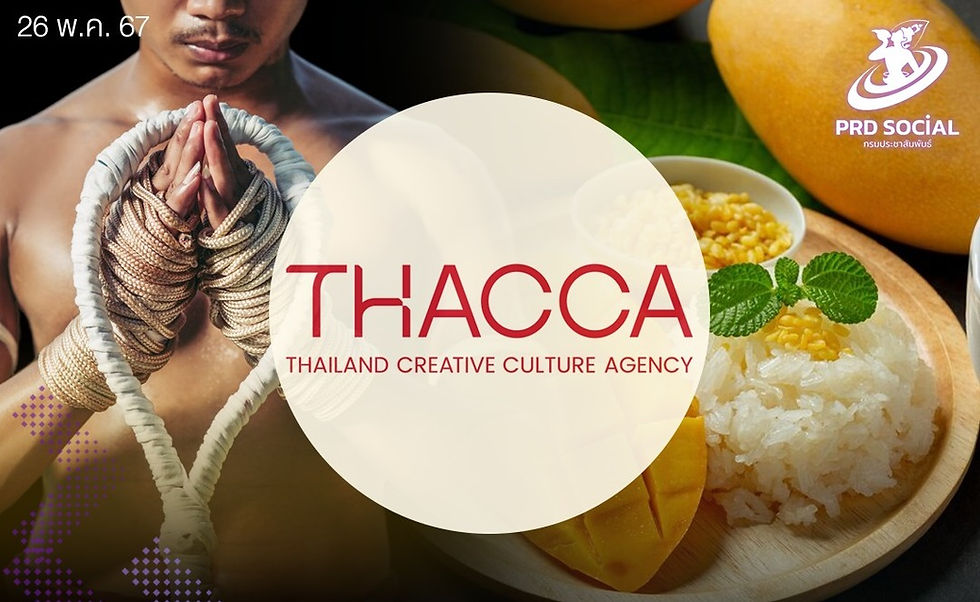
What Thailand Is Building
THACCA's designers have named their references — Korea's KOCCA, Taiwan's TAICCA, France's CNC — but the design is Thailand's own synthesis. The planned toolkit includes a one-stop service for film registration, licensing, and incentives; direct project funding (roughly US$6.7 million invested in 30–40 Thai films, series, documentaries, and animation projects across 2024–25); an increase of the foreign-production location incentive from 20% to 30%; an overhaul of the outdated Film Act; and a new international film festival.
What makes THACCA distinctive is its scope. None of its reference models covers anything close to 11 industries; THACCA's mandate folds gastronomy, sports, festivals, and tourism in alongside content genres. This is not imitation drift — it reflects the actual structure of Thailand's cultural economy, where exports run heavily through food and visitor-facing experiences. THACCA is, in effect, the first attempt anywhere to govern content IP and tourism-facing cultural promotion inside one institution. If it works, it offers a template suited to Southeast Asian conditions in a way no imported model is.
Where Things Stand: A Timeline of Turbulence
The institution-building has run slower than the policy ambition. The founding legislation — drafted by the Office of the Council of State and intended to transform the existing Creative Economy Agency into THACCA proper — was originally expected to pass parliament by late 2024. The target then slipped to agency operation by the first quarter of 2026. As of mid-2026, THACCA remains a subsidiary unit of the Strategic Transformation Office: it has a website, a brand, programs, and staff, but no independent legal personality or budget line of its own.
Politics has been the main brake. The Soft Power Strategy Committee has been dissolved and reconstituted with each change of prime minister — ending with Srettha Thavisin's removal in August 2024, reappointed under Paetongtarn Shinawatra that October, and dissolved again following her departure in 2025, with the current government inheriting an approved budget but an unfinished institution. Funds continue to flow — about 3.9 billion baht was allocated to the soft-power strategic plan for FY2026 — but they are disbursed through individual ministries rather than through the agency the strategy was built around.
The Numbers Behind the Narrative
Parliamentary and Senate scrutiny intensified through late 2025, and the figures explain why. Total soft-power spending across 2024–2025 approached 8 billion baht once ministry-level projects are counted — far beyond the 635 million baht officially attributed to the committee. The flagship OFOS skills program, designed to train 20 million Thais, recorded roughly 20,000 completed trainees in its first two years against more than 900 million baht in allocations. Oversight committees are now examining procurement practices and asking the harder question: whether the spending is producing measurable soft-power outcomes or national income.
Part of an ASEAN Institutional Wave
THACCA should be read alongside its regional peers, because Southeast Asia is in the middle of a wave of creative-economy institutionalization. The Philippines legislated first: the Creative Industries Development Act of 2022 created a cabinet-level council, satellite accounts now track the sector (₱2.12 trillion in 2025), and Manila has declared the goal of leading ASEAN's creative economy by 2030. Indonesia went further institutionally, elevating creative economy to a standalone ministry in late 2024. Thailand chose a third path: not a council, not a ministry, but a powerful executing agency.
Each design answers the same underlying question differently — where should creative-economy authority sit so that it survives politics and actually moves money? That makes THACCA's trajectory consequential well beyond Thailand. For tourism-weighted creative economies — which is to say, most of ASEAN — Thailand is running the live experiment on whether an integrated content-plus-tourism agency can convert visitor economies into IP-producing ones. Its peers will inherit the lessons either way.
What the Korean Case Offers as Reference
Since Thailand's designers cite Korea's KOCCA as a primary reference, it is worth asking what in the Korean experience is actually transferable. Three lessons stand out — and none of them is the agency structure itself.
Statute before structure. Korea's content-promotion apparatus survived repeated changes of government because it rested on legislation — beginning with the Framework Act on the Promotion of Cultural Industries in 1999 — that gave agencies legal personality, their own budget lines, and mandates no incoming cabinet could simply switch off. Thailand's committee, created by prime ministerial order, has already been dissolved twice in two years. The lesson is blunt: pass the law first; institutions built on executive orders die with their authors.
Patient capital before export success. Korea's content funds operated for more than a decade — through multiple administrations — before Hallyu became a measurable export phenomenon. The financing was structured as long-horizon funds rather than annual event budgets, which protected IP development from the temptation to spend on visible, short-cycle festivals. For Thailand, where festival and event spending dominates the current portfolio, this is the most directly applicable caution.
Distance from power cuts both ways. THACCA's PM-chaired, top-down design maximizes political drive — but Korea's own history shows the cost of proximity. The political interference in cultural funding that surfaced in Korea in the mid-2010s became a national controversy precisely because promotion bodies sat close enough to power to be instrumentalized. An arm's-length governance layer is not bureaucratic decoration; it is what allows a creative agency to outlive the government that founded it. Thailand, having watched its strategy committee dissolve with each prime minister, has already experienced the early form of this problem.
The sequencing point matters too: in Korea, content IP exports came first and inbound tourism followed as a consequence. Thailand is attempting the reverse — building from a tourism base toward IP. The Korean record does not say this is impossible; it says the test will be whether tourism revenue is reinvested upstream into IP-creating capacity rather than recycled into the next event.
What to Watch
Four markers will indicate where this is heading over the next year: passage of the THACCA founding act in parliament, which would finally give the agency legal personality and its own budget; whether the current government keeps the PM-chaired governance structure or moves toward an arm's-length design; the outcome of Senate budget reviews, which will shape public legitimacy; and whether the 30% location incentive and Film Act reform proceed on schedule — the two measures with the clearest near-term industry impact. A fifth, regional marker: whether the Philippines' 2026 ASEAN chairmanship turns these national experiments into a shared regional agenda.
Key References
National Soft Power Strategy Committee establishment (PM Office Order 230/2023) and reconstitution records
Bangkok Post and Nation Thailand reporting on the Creative Culture Promotion Act and THACCA launch timeline (2023–2025)
Thai Enquirer and Senate Budget Oversight Committee figures on soft-power spending and OFOS outcomes (Sept. 2025)
Deadline, TCCF coverage of THACCA's content-industry toolkit (Nov. 2024)
Republic Act No. 11904 (Philippines, 2022); PSA Creative Economy Satellite Accounts (2026); Indonesia Ministry of Creative Economy establishment (2024)
Framework Act on the Promotion of Cultural Industries (Korea, 1999); THACCA official site (thacca.go.th); ISEAS Perspective 2025/44


