

When the City Becomes the IP (Part 2): Pathways to Urban IP & Measuring Success in ASEAN Cities
1. Impact of UNESCO Creative City Designation
The UNESCO Creative Cities Network (UCCN) integrates culture directly into urban development strategy. Within ASEAN, designation operates as a major catalyst for creative-sector growth — but the emphasis belongs on catalyst.
Thailand — Multi-City System Strategy
Thailand holds five UCCN-registered cities: Phuket (Gastronomy), Chiang Mai (Crafts & Folk Art), Bangkok (Design), Sukhothai, and Phetchaburi.
Bangkok connects regional talent to global markets. According to the Creative Economy Agency (CEA), Thailand's creative industries generate roughly 1.44 trillion THB annually (~8.01% of national GDP).
Chiang Mai functions as a living center of crafts — Lanna silverwork, textiles, woodcarving — sustaining heritage through creative enterprise.
Phuket generates roughly USD 12 billion in tourism revenue annually, strongly anchored by its gastronomic identity.
Empirical caveat. A 2025 quantitative study (Asia-Pacific Journal of Regional Science) analyzing Thai creative cities found that while a city's enabling business environment boosted regional GDP, "cultural vibrancy" alone did not automatically yield economic gains. Designation provides visibility; conversion requires supporting infrastructure.
Vietnam — Top-Down National Strategy
Vietnam stands out for a Prime Minister–approved national strategy targeting 4 to 6 UNESCO Creative Cities by 2030. Following the simultaneous 2023 designations of Hoi An (Crafts & Folk Art) and Da Lat (Music), Vietnam demonstrates how creative-city status can be deployed as a systematic national urban-policy instrument.
2. Four Pathways: Transforming the City into IP
Pathway | Model | Anchor Example(s) |
1. Product / Genre | A signature product or genre becomes the city's brand | Da Lat (Vietnam) |
2. Festival-Anchored | Recurring events convert districts into hubs | George Town / Ubud |
3. Adaptive-Reuse | Historic spatial stock becomes creative platform | Bangkok "City as a Stage" |
4. Screen Tourism / Location IP | Media narratives become spatial assets | Cambodia, Thailand, Vietnam & Singapore |
2.1 Product / Genre-Anchored Model: Da Lat, Vietnam
Following its 2023 UNESCO designation as a City of Music, Da Lat linked its urban branding directly to national policy under Prime Minister's Directive No. 30-CT/TTg (August 2024).
Anchor assets: "City of Fog / Flowers" storytelling heritage, combined with highland coffee, French colonial architecture, and music spaces.
Implementation focus: Following administrative restructuring in Lam Dong province (July 2025), public–private partnerships (PPP) are being deployed to build long-term governance structures for the 2024–2027 UNESCO commitment window.
2.2 Festival-Anchored Model: Event-Driven Urban Hubs
George Town Festival & GTLF (Malaysia) — combines 100+ art events with UNESCO World Heritage architecture. The George Town Literary Festival (GTLF) serves as the region's premier literary-tourism anchor.
Ubud Writers & Readers Festival (Indonesia) — a 2022 impact study reported visitor spend of IDR 1.3M per stay, boosting nearby SME revenues by 25–50% and lifting local hotel occupancy by 32.5 percentage points.
Bangkok Design Week 2026 — held across 140+ venues (Charoen Krung, Talat Noi, Phra Nakhon), transforming city districts into active policy and business launchpads.
The spatial-concentration caveat. Research by Throsby et al. on the Ubud festival highlights that economic gains tend to cluster strictly within a limited radius near the festival core. This is a recurring pattern, not a local anomaly — as the global benchmarks below confirm, the same concentration appears in Japan and Europe. Planners should budget for it explicitly rather than assume diffusion across a whole city.
Highlight — The "Heritage Novel Circuit" & Immersive Gen Z Travel. A prominent 2025–2026 trend is the rise of curated "heritage novel circuits" and set-jetting literary tours. Promoted via municipal tourism boards, walking tours connect story settings across Penang, Singapore (Fort Canning), Manila (Intramuros), and Ubud — turning literature and local history into real-world spatial IP and diverting Gen Z travelers away from overcrowded hotspots toward story-driven urban heritage.

2.3 Adaptive-Reuse Model: Bangkok's "City as a Stage"
In 2026, Thailand's Creative Economy Agency (CEA) formalized the "City as a Stage" framework, treating historic spatial stock as creative platforms:
Warehouse 30 — a WWII-era warehouse complex transformed into a 4,000 m² creative cluster.
TCDC Grand Postal Building — landmark adaptive retrofitting demonstrating historic preservation without demolition.
Pilot creative districts — tailored identities across Charoen Krung (Design/Digital), Chiang Mai (Crafts/Culinary), and Bang Saen (Coastal Creative Tourism).
2.4 Screen Tourism & Location IP Model: Turning Media Narratives into Spatial Assets
Global film and television productions increasingly operate as high-yield catalysts for regional tourism and spatial branding across ASEAN. By combining international location incentives with set-jetting travel trends, cities convert screen exposure into physical tourism footprints. Notably, ASEAN states pursue this through two distinct support types — direct fiscal rebates and administrative facilitation — a governance distinction worth making explicit.
Cambodia — Facilitation-Led Support & Heritage Set-Jetting. Cambodia is an early pioneer of heritage screen tourism, dating to Lara Croft: Tomb Raider (2001), which put Siem Reap's Ta Prohm temple on the global map. Crucially, Cambodia's model is facilitation-led rather than rebate-led: the Cambodia Film Commission (CFC), under the Ministry of Culture and Fine Arts, offers import-tax exemption on filming equipment, location scouting, permit fast-tracking, and production services — but no national cash rebate. Historic complexes and urban heritage sites are positioned directly as "ready-to-film spatial IP," capturing high-spending crews and driving long-term pop-culture pilgrimage.
Thailand — The "White Lotus Effect" & Production Rebates. Thailand runs one of the region's most sophisticated fiscal incentive schemes. Effective 1 January 2025, foreign productions can receive a cash rebate of up to 30% (a 15% base rate plus uplifts for Thai crew, cultural promotion, designated-province filming, and local post-production), and the previous THB 150 million payout cap has been removed to attract large-budget productions. The filming of HBO's The White Lotus Season 3 across Bangkok, Phuket, and Koh Samui catalyzed massive global search spikes and booking interest — the "White Lotus Effect." Beyond search buzz, the production itself injected an estimated USD 36.5 million in local spending and employed roughly 1,000 local crew, a concrete flow of production expenditure that Thailand explicitly leverages to redistribute traffic toward regional coastal and urban districts.
Singapore & Vietnam — K-Drama & Global Streaming Set-Jetting. Global streaming platforms (Netflix, Disney+) and international co-productions have birthed dedicated location trails. Destinations such as Singapore's urban landmarks and Vietnam's iconic landscapes (e.g., Da Nang, Ninh Binh) capitalize on on-screen appearances by introducing official digital walking maps and guided set tours, converting cinematic fiction into real-world foot traffic.
The Screen Tourism IP Value Chain
1. State Support | 2. Media Exposure | 3. Spatial Monetization |
Fiscal rebate or facilitation | Global streaming / TV | Set-jetting trails |
Cash-back / permit fast-tracking | Narrative placement | Heritage branding |
Strategic takeaway. Screen tourism is no longer passive promotional exposure; it is a structured economic framework. High-performing ASEAN cities actively pair either cash rebates or production-support facilitation with post-broadcast digital navigation and walking tours — turning temporary film sets into durable cultural-content IP. The choice between a fiscal and a facilitation model is itself a policy lever, with different budget implications and different exposure to "race-to-the-bottom" rebate competition.
3. Global Benchmark: Lessons from Europe and Japan
The monetization of urban space as cultural IP is not unique to Southeast Asia. Facing demographic decline and post-industrial transition, Europe and Japan pioneered strategies that convert cultural assets, flagship architecture, and regional narratives into economic engines. Their track records are instructive precisely because the headline success stories, examined closely, reveal the same conditions and the same limits that ASEAN cities now face.
Model Type | City & Location | Core IP / Strategy |
Architectural IP | Bilbao, Spain | Guggenheim / landmark museum |
Contemporary Art & Island | Naoshima, Japan | Benesse Art Site / regeneration |
Industrial Retrofit | Ruhr Valley, Germany | Zollverein / industrial heritage |
Media & Anime IP | Oarai / Numazu, Japan | Anime pilgrimage (seichi junrei) |
3.1 Europe: Architectural Icons & Post-Industrial Heritage
Bilbao, Spain — The "Bilbao Effect." Faced with severe industrial decline in the 1980s, Bilbao partnered with the Solomon R. Guggenheim Foundation to build Frank Gehry's titanium-clad Guggenheim Museum Bilbao (opened 1997). It operated as a single, powerful piece of architectural IP, transforming a struggling port city into a global cultural capital.
Read the payback figure carefully. Popular accounts claim the museum "recovered its construction cost within three years" — but that figure relies on gross tourist expenditure and tax collected on it, not on net recovery of the public investment. Peer-reviewed analysis (Beatriz Plaza, University of the Basque Country) finds the initial public investment took roughly 7 to 9 years to recover through tax revenues, at an estimated ROI of ~10.9%. The distinction matters: gross visitor spending and net public-investment recovery are different ledgers, and conflating them is exactly how "miracle" narratives are manufactured.
Ruhr Valley, Germany — Industrial Heritage Trail. Rather than demolishing former coal mines and steelworks, the Ruhr region repurposed heavy-industrial sites into cultural platforms under the Route der Industriekultur. The Zollverein Coal Mine Complex in Essen was designated a UNESCO World Heritage site (2001) and transformed into a hub for design exhibitions, music venues, and museums — converting industrial decay into a regional tourism identity.
3.2 Japan: Regional Revitalization Amid Demographic Decline
Naoshima (Kagawa Prefecture) — Contemporary Art & Island IP. Once an aging, depopulated island burdened by industrial waste, Naoshima collaborated with the Benesse Corporation to create the Benesse Art Site Naoshima. Featuring Tadao Ando's underground architecture and Yayoi Kusama's iconic waterfront Pumpkin, the island rebranded as a global contemporary-art destination — now expanded into the Setouchi Triennale. The island draws over 500,000 visitors a year, rising toward 1 million during the Triennale, with more than half arriving from abroad. The inaugural 2010 Triennale drew 938,246 visitors against a 300,000 estimate, and the Bank of Japan's Takamatsu branch reported economic benefits exceeding ¥11.1 billion.
Visitors are a flow; residents are a stock. Despite the staggering visitor figures, many of the host island communities have only a few hundred — sometimes a few dozen — residents, with high proportions aged 65 and over, and some face outright existential decline. High visitor flow has not automatically restored the resident stock. For ASEAN planners, this is the central lesson: a successful destination and a sustained community are not the same achievement.
Oarai & Numazu — Anime Location Pilgrimage (seichi junrei). Japanese local governments partner with anime production committees to turn townscapes into spatial IP. Oarai (Ibaraki) linked its identity with Girls und Panzer; Numazu (Shizuoka) leveraged Love Live! Sunshine!!. Municipalities introduced official location maps, character-branded transit, and festival crossovers. Oarai — a town of under 20,000 — saw annual visitors recover from roughly 1.5 million during the post-earthquake slump to 2.2–2.4 million by 2014–15, and its Anglerfish Festival more than doubled from ~30,000 to 70,000–80,000.
Two warnings before importing this model. Survivorship bias. Lucky Star (Kuki), Girls und Panzer (Oarai), and Love Live! Sunshine!! (Numazu) are cited endlessly as proof of concept — but they are exceptional outcomes shaped by unique circumstances (including post-disaster "support consumption"). Focusing on the winners while ignoring the many towns that saw no lasting benefit produces unsupported conclusions. "We could get a White Lotus effect too" is precisely the reasoning to be wary of. Uneven distribution. Even in Oarai, the "billions of yen" benefit concentrates among shops along the main shopping street; retailers even a short distance away see little flow. The claim that an effect "spread across the whole town" is optimistic — the same spatial-and-sectoral concentration that Throsby documented in Ubud.
Strategic Takeaways
Public–private partnership is structural, not optional. Both Bilbao (Guggenheim Foundation) and Naoshima (Benesse) show that large-scale urban IP requires sustained private-sector collaboration, not pure municipal subsidy.
Beyond top-tier megacities. Japan's anime-pilgrimage towns prove that smaller regional towns facing youth out-migration can capture high-value, highly engaged niche segments — if they build genuine relationships with rights-holders rather than merely plastering imagery.
Preservation via re-interpretation. The Ruhr model reinforces ASEAN's circular-economy agenda: heritage is best preserved not by sealing it away, but by converting historic fabric into active cultural platforms.
Budget for concentration, and separate your ledgers. Across every benchmark, benefits concentrate spatially and by sector, and gross figures routinely overstate net community gain. Plan for distribution, and measure net.
4. Critical Policy Challenges & Measurement Infrastructure
The Broken Causality Between Designation and Growth
Empirical research — in ASEAN and in the mature economies benchmarked above — confirms that neither UNESCO designation, festival hosting, nor a screen-tourism moment automatically generates long-term prosperity. Designation provides visibility; actual economic conversion depends on supportive infrastructure, clear performance metrics, and industrial integration.
Authenticity vs. Commercialization
As highlighted in ASCC policy discussions, aggressive IP capitalization risks driving gentrification and community displacement in cities such as Chiang Mai, George Town, and Bandung. Without community-first safeguards, creative-city branding risks reducing cultural value to real-estate speculation.
Measurement Infrastructure: Indonesia's Creative City Framework
To commercialize urban IP responsibly, cities need robust diagnostic tools. Indonesia leads the region in multi-layered creative-economy indexing:
Bottom-Up: Creative City Index (IKK) | Top-Down: PMK3I Platform |
Developed by civil network (ICCN) | Run by Kemenparekraf |
Evaluates sub-sector value chains | Official government audit |
Applied across 27 West Java cities | National dashboard & registry |
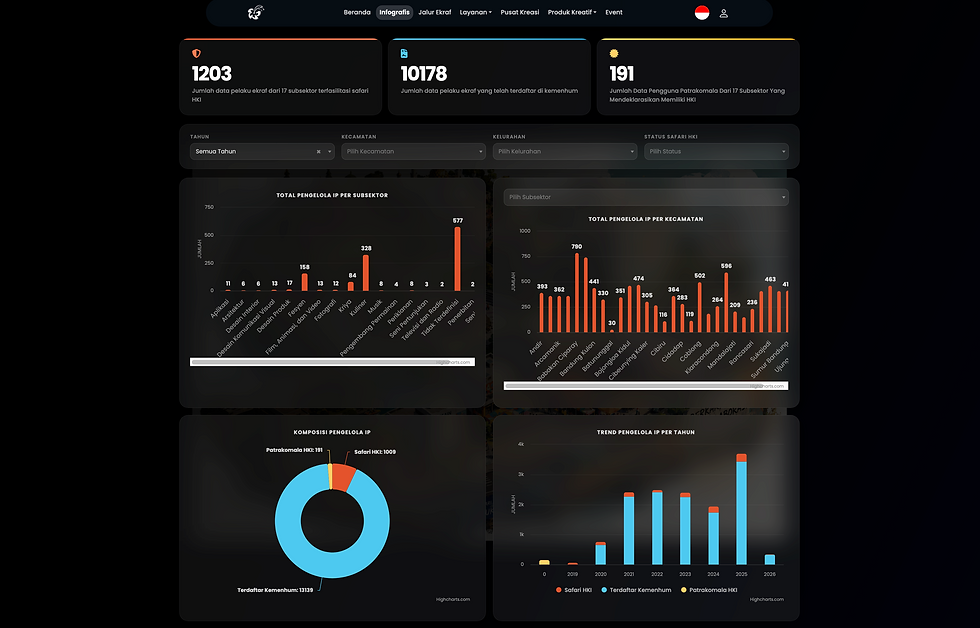
Bandung City Index (Patrakomala). Bandung evaluates creative activity at the granular district (kecamatan) level through a dedicated portal, mapping facilities, community events, and economic output to guide local spatial policy directly.
Regional institutionalization. The British Council–ASEAN Regional Perception Poll (2025) explicitly recognized urban spatial design — "the design of towns, streets, and public spaces" — as a core measurable domain of the regional creative economy.
Conclusion: Key Takeaways for Regional Urban Strategy
Infrastructure precedes identity. A title, a festival, or a film set alone does not yield sustainable growth. Success depends on local measurement systems, adaptive-reuse policy, and digital distribution networks.
Narrative is a competitive advantage — with an asterisk. As travel markets lean toward authenticity, cities that convert local literature, gastronomy, architecture, and screen exposure into cohesive brand IP will lead ASEAN's urban regeneration. But the global record is unambiguous: attention concentrates, gross overstates net, and the winners are cited far more often than the many who tried. The strategic task is not to manufacture a viral moment — it is to build the infrastructure that lets one become durable, and to measure honestly whether it did.
References & Key Policy Channels
Regional Policy Frameworks (ASEAN Official)
ASEAN Creative Economy Sustainability Framework (May 2025) — asean.org
ASCC Policy Brief No. 32 & Trend Report (April 2026) — asean.org
ASEAN Tourism Outlook 2025 (October 2025) — asean.org
ASEAN Stats Data Portal — data.aseanstats.org
Institutional & National Portals
UNESCO Creative Cities Network (UCCN) — unesco.org/en/creative-cities
Creative Economy Agency (CEA, Thailand) — cea.or.th | creativecity.cea.or.th
Thailand Film Office (TFO) — tfo.dot.go.th
Cambodia Film Commission (CFC) — Ministry of Culture and Fine Arts
Bangkok Design Week — bangkokdesignweek.com
Da Lat Creative City of Music — dalatcreativecity.com
Kemenparekraf Creative City Platform (PMK3I) — kotakreatif.kemenparekraf.go.id
Patrakomala Bandung Portal — patrakomala.disbudpar.bandung.go.id
Indonesia Creative Cities Network (ICCN) — iccn.or.id
This is Part 2 of a two-part series. See Part 1 for regional policy frameworks and macro tourism data.
