Indonesia's Batik Economy: From UNESCO Heritage to Global IP Asset (1)
Updated: Apr 15
Introduction
When UNESCO recognized Indonesian batik as an Intangible Cultural Heritage of Humanity in 2009, the designation triggered something beyond international prestige. It sparked a decades-long reckoning with a fundamental question: how does a country protect, commercialize, and scale a cultural asset that is simultaneously a living craft tradition, a national identity marker, and an increasingly contested piece of intellectual property? Indonesia's response — still evolving, and still incomplete — has made batik one of the most instructive case studies in ASEAN on the relationship between cultural heritage and the creative economy.
What makes the batik question particularly significant is not its uniqueness, but its typicality. Across ASEAN, governments are grappling with the same structural problem: how do you convert a collectively held, historically rooted creative tradition into a defensible economic asset in a globalized marketplace that does not wait for cultural governance to catch up? The answer has real consequences — for artisan livelihoods, for national soft power, and for the emerging institutional architecture of the ASEAN creative economy itself. Batik is where that argument has been most clearly, and most publicly, joined.

1. Batik as Economic Asset: The Scale of the Opportunity
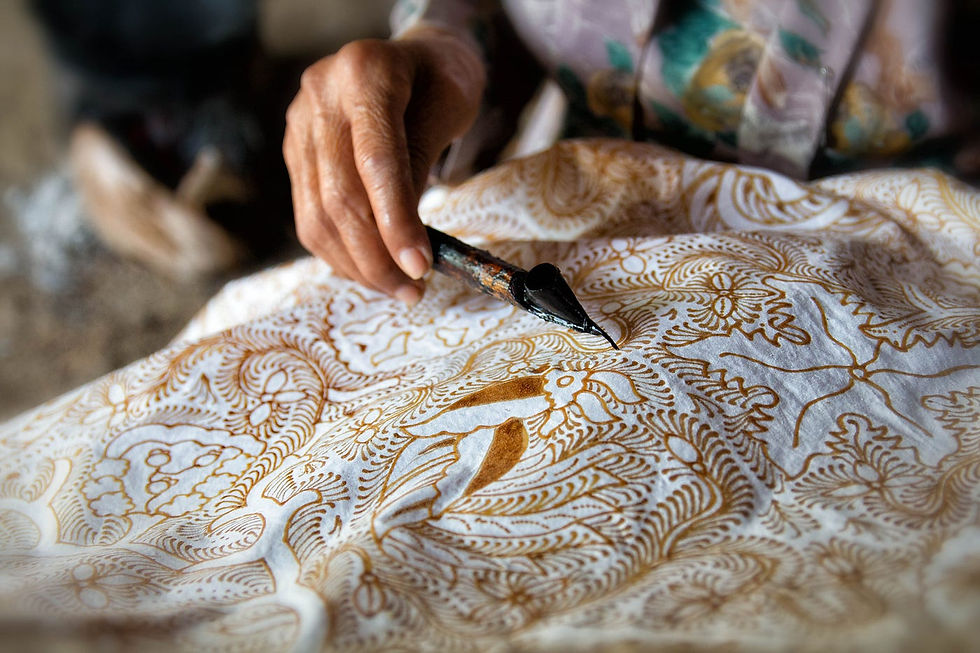
Batik is not a small-scale artisanal curiosity. It is an industry. Exports grew from approximately USD 22 million in 2010 to USD 340 million by 2014, reflecting the surge in international demand that followed the UNESCO designation. The industry spans hand-drawn batik (batik tulis), which commands premium prices and is produced by skilled artisans using traditional wax-resist (canting) techniques, and printed batik (batik cap and machine-printed), which dominates mass-market volume.
Indonesia's broader creative economy puts this into sharper relief. The sector is projected to contribute over Rp 1.5 trillion to GDP in 2024 and employs an estimated 26.5 million people, with fashion — which includes batik — among the leading subsectors alongside culinary arts, film, music, and applications development. Between 2015 and 2024, total IP applications in Indonesia rose from approximately 74,893 to 339,304, averaging 18.5% annual growth annually — a figure that signals rising institutional awareness of brand and innovation protection even as enforcement gaps persist.[¹]
Indonesia's broader IP landscape tells a parallel story of rapid formalization. Between 2015 and 2024, copyright applications rose from fewer than 6,000 to over 178,000, while trademark applications nearly doubled to approximately 136,000. SMEs accounted for 86.76% of all IP applications in that period, with fashion and food & beverages as leading sectors. In the first half of 2025 alone, 152,115 IP applications were filed nationally — a 20% increase over the same period in 2024. The WIPO Director-General, visiting Indonesia's IP Xpose event in 2025, noted that Indonesia — historically known as "Nusantara, a land of culture, heritage and innovation" — is actively building institutional infrastructure to convert cultural assets into protected commercial value.[²] Batik sits at the center of this transformation, serving as both the most visible test case and the most visible point of failure.
One structural indicator worth noting: Indonesia's Directorate General of Intellectual Property (DGIP) has designated thematic years to spotlight different IP categories — Geographical Indications (2018 and again 2024), Industrial Design (2019), Patents (2021), Copyright (2022), and Trademarks (2023). The return to Geographical Indications as a theme in 2024 signals that this instrument — directly relevant to batik and other place-origin heritage products — remains an unfinished policy project, not a solved one.[³]
2. The IP Architecture: What Protects Batik, and What Doesn't
The intellectual property protection of batik is more complex than it might appear, and the complexity has real economic consequences. There is no single instrument that adequately covers it. Instead, multiple overlapping regimes apply imperfectly, each with distinct limitations.
Copyright arises automatically in Indonesia, as in most jurisdictions, but its application to batik is far from straightforward. To attract copyright protection, a specific batik design must demonstrate sufficient originality — a high bar for motifs that have been produced communally for generations and whose precise authorship is often indeterminate or distributed across families and workshops. The Solo local government has registered a number of traditional patterns as copyrights, but this approach creates its own problems: it generates disputes among producers, sometimes between families, over who holds rights to a motif, and does nothing to stop copying across national borders.[⁴]
Industrial Design registration offers a potentially stronger instrument for batik motifs applied to mass-produced fashion products. When a batik pattern is reproduced on a garment, phone case, or accessory through a commercial manufacturing process, industrial design law — which protects the visual appearance and form of a product — may provide more enforceable protection than copyright. This dimension of batik IP protection is significantly underutilized.[⁵]
At the broadest level, the 2009 UNESCO designation itself functions as a soft form of protection, establishing Indonesian origin as the international reference point for batik as a cultural category. The government has introduced the Batik-mark certification system, operated by the Yogyakarta Grand Handicraft and Batik House, which certifies that a product is genuine Indonesian batik and helps establish origin credibility in domestic and export markets. Even the Batik-mark label itself has been registered at the Indonesian Copyright Office — an attempt to give the certification instrument its own protected status.[⁴]
However, Batik mark certification provides protection only within Indonesia. To secure IP rights internationally, individual manufacturers must independently file for design patents, copyright registration, or trademark protection in each target market — a process that is both expensive and operationally complex for the small and medium enterprises that constitute the overwhelming majority of the batik industry. The result is a structural vulnerability: Indonesian batik patterns are regularly copied by textile manufacturers in other countries, particularly in Asia and Africa, with limited legal recourse available to the original producers.
Trademark is increasingly relevant as batik moves from craft product to branded category. Indonesia's 2016 Trademark Law and Geographical Indication Law (Law No. 20/2016) allows registration of collective marks — potentially useful for regional batik producer associations — though uptake remains low. The Constitutional Court amended the non-use cancellation period in 2024 (Decision No. 144/PUU-XXI/2023), extending it from three to five years, a reform explicitly motivated by the need to support SMEs facing economic disruptions.[⁶]
Geographical Indications (GI) represent the most promising but most underdeveloped instrument for batik protection. A GI links the commercial use of a product name to a specific geographic origin, offering collective protection without requiring individual registration. As of 2024, Indonesia managed 138 geographical indications, many linked to cultural and agricultural heritage products, and the government's 2024 thematic year explicitly prioritized GI promotion through programs like "GI Goes to Marketplace," "GI Drafting Camp," and improved monitoring for registered GIs. For batik, the GI route is complicated by the fact that batik production is not confined to a single region: major centers include Yogyakarta, Solo, Pekalongan, Cirebon, and Madura, each with distinct stylistic traditions — which both complicates unified GI registration and potentially enables multiple regionally specific GIs, as with Scotch Whisky and Irish Whiskey in the European context.[⁴]
In October 2024, Indonesia enacted Law No. 65, amending the 2016 Patent Law to align with international standards, streamline filings, and strengthen licensing provisions — including clearer guidelines on compulsory licensing in national security contexts and stricter reporting requirements for patent holders. Separately, a revision to the 2014 Copyright Law is currently under development as part of the National Legislation Program, with a focus on expanding protections within digital and technological ecosystems. These reforms are part of a broader modernization effort, but they do not yet fully resolve the internationalization gap that leaves batik producers exposed in foreign markets.[⁷]
Indonesia continued to appear on the USTR's Priority Watch List in both 2024 and 2025 Special 301 Reports, with the 2025 Report noting that local manufacturing of counterfeits has increased and counterfeit sales have shifted substantially to online platforms — both trends directly relevant to the batik sector.[⁸]
3. The Tension Between Tradition and Commercialization
Indonesia's batik economy faces a structural tension that is familiar across ASEAN's heritage creative industries: the most economically valuable form of the product — hand-drawn batik tulis, produced by skilled artisans using traditional wax-resist techniques — is also the most difficult to scale, the most vulnerable to imitation, and the most dependent on a shrinking pool of practitioners.
Hand-made batik competes unfavorably on price with printed alternatives. The production of a single batik tulis piece can take weeks or months, while mass-printed substitutes with similar visual characteristics are available at a fraction of the cost. Raw material supply chains — particularly for natural dyes and quality wax — are unstable. Artisan regeneration is a persistent concern: many traditional batik workshops struggle to attract apprentices, as younger generations weigh the low wages of craft labor against other economic opportunities. Yet it is precisely the artisanal quality, cultural depth, and verified handcraft of batik tulis that generates premium value, the UNESCO recognition, and the authentic branding that distinguishes Indonesian batik from its imitators.
This is a version of what cultural economists call the "productivity lag" in performing arts — a structural tendency for craft production costs to rise relative to productivity gains, since the work itself resists mechanization without becoming a different product. The analogy to live performance is instructive: a batik tulis produced in two months is not substitutable, from a cultural-value standpoint, by a machine-printed approximation, in the same way that a recorded concert does not substitute for a live one. IP instruments help, but they cannot resolve this underlying economic asymmetry.
The tension also has a political dimension that IP law leaves largely unaddressed. The Indonesia–Malaysia dispute over batik origins — which flares periodically and intensifies with each new international platform — illustrates how cultural heritage claims function geopolitically in ASEAN. Both countries produce batik with centuries of local tradition; the UNESCO designation in favor of Indonesia reflects a particular moment in international cultural diplomacy, not an uncontested historical settlement. The dispute underscores that cultural heritage claims are not simply IP questions: they implicate national identity, diplomatic relations, and the politics of origin in ways that legal frameworks alone cannot manage.[⁴]
This tension is not unique to batik. It appears across ASEAN's handicraft, fashion, and craft industries wherever heritage-based production meets commercial scale and cross-border replication. Indonesia's policy response has focused on entrepreneurship development, digital platform integration for artisans, geographic indication registration, and the OVOB (One Village, One Brand) program under the DGIP's trademark agenda — which promotes collective brand registration for local products and aims to translate IP into concrete community economic value.[³]
References
[1] AFFA Intellectual Property Rights. "Why Indonesia Is the Next Big Market for Foreign Brands — and How IP Can Protect Your Growth." August 2025. https://affa.co.id/global/2025/08/20/why-indonesia-is-the-next-big-market-for-foreign-brands-and-how-ip-can-protect-your-growth/
[2] China Intellectual Property Lawyers Network / IP Express. "Indonesia Pledges to Speed Up Digital IP Transformation at WIPO Assembly." 2025. https://www.ciplawyer.com/articles/157124.html
[3] AFFA Intellectual Property Rights. "Not Just Batik: Why Industrial Design Is the Hidden Gem of IP in Indonesia." June 2025. https://affa.co.id/global/2025/06/23/not-just-batik-why-industrial-design-is-the-hidden-gem-of-ip-in-indonesia/
[4] IP Komodo. "Indonesian Batik and IP Protection." Blog. http://ipkomododragon.blogspot.com/2011/10/indonesian-batik-and-ip-protection.html
[5] AFFA Intellectual Property Rights. "Not Just Batik: Why Industrial Design Is the Hidden Gem of IP in Indonesia." June 2025. https://affa.co.id/global/2025/06/23/not-just-batik-why-industrial-design-is-the-hidden-gem-of-ip-in-indonesia/
[6] Asia IP Law. "Indonesia IP Guide 2025." https://asiaiplaw.com/sector/copyright/indonesia-ip-guide-2025
[7] US Commercial Service. "Indonesia — Protecting Intellectual Property." Country Commercial Guide 2024–2025. https://www.trade.gov/country-commercial-guides/indonesia-protecting-intellectual-property
[8] US Trade Representative (USTR). "2025 Special 301 Report on Intellectual Property Protection and Enforcement." April 2025. https://ustr.gov/about/policy-offices/press-office/press-releases/2025/april/ustr-releases-2025-special-301-report-intellectual-property-protection-and-enforcement