The Charts Went Local. The Rights Did Not.(Part 1)
Two things ASEAN's music data does not measure
Local repertoire is taking Southeast Asian charts, and the shift is real. But the statistics being celebrated measure only one thing, and it is not the thing that determines where value settles. This first part sets out what the 2026 data shows and identifies two blind spots in it. Part 2 turns to who controls the measurement, why ASEAN is not one market, and what policy actually transfers.
The platform paradox
Borderless distribution was supposed to flatten taste. The assumption behind the first decade of global streaming was straightforward: remove the friction of physical distribution, and the world converges on a single chart, dominated by whoever holds the largest promotional budget. Anglophone pop would become the default, and everything else would remain regional colour.
The opposite happened, and for a structural reason worth naming precisely. Once catalogue distribution costs approach zero, distribution stops being the scarce resource — recommendation does. And recommendation systems optimise for retention, which is highest where the listener finds language, idiom, humour, and social reference they already inhabit. The global platform, pursuing its own engagement metrics, became a machine for surfacing local repertoire.
The evidence is now unambiguous across three continents:
Indonesia. Domestic artists — Tulus, Mahalini, Bernadya, Hindia — now hold long tenancies at the top of the national Spotify chart, and regional acts from outside Jakarta are entering rotation. The widely quoted figure that Indo-Pop rose from 60% to 78% of Indonesian streaming comes from an independent analyst rather than from Spotify or IFPI; the direction is well attested, the precise magnitude is not. See A note on sources below — and note that Indonesia's absence from the one rigorous comparative dataset, discussed later, is precisely why a weaker source is being leaned on here at all.
The Philippines and Thailand. P-Pop acts such as SB19 and BINI convert visual performance into sustained chart and video presence, and Thai agencies have built T-Pop rosters with genuine domestic followings. As the later section on regional divergence shows, however, these two markets sit at opposite ends of the local-share spectrum, and it is a mistake to file them under one heading.
Europe. French-language rap and pop have held the domestic singles charts long enough that the pattern is no longer treated as a cycle. Germany is more ambiguous than the localism literature usually allows: domestic-language acts perform strongly on the charts, yet Luminate ranks Germany among the world's most internationally open markets, with roughly three-quarters of German streamers listening to artists from other countries. Chart position and listening share are not the same measurement.
The United States. This is the number that matters most, and it comes in two forms that must not be confused. Measured in streams: English-language share of on-demand audio fell to 86% in Q1 2026, down from 88.1% a year earlier, while Spanish reached 9.5% — close to one stream in ten. Measured in people: Luminate's consumer survey finds that casual monthly Latin listenership rose from 41% of US listeners in early 2024 to 56% in Q1 2026. The second figure is audience reach, not streaming share — more than half of US listeners now put Latin music in their rotation, which is an entirely different statement from Latin music holding half of US streams. It does not.
The US case is decisive because it retires the crossover premise. Latin repertoire did not anglicise, dilute, or seek a legitimating feature from an Anglophone star. Bad Bunny and Peso Pluma took the region's own rhythmic grammar, its wind instruments, its narrative conventions — and the largest music market in the world adjusted to them. Cultural specificity turned out to be the hook, not the obstacle.
A caution before the chart below, because none of these figures share a denominator and they should not be read against one another. Three distinct measurements are in play: the quarterly release counts on-demand audio across all tracks (86% / 9.5%); the annual series below counts audio plus video across the top 10,000 tracks only (87.1% / 9.4%); and the listenership figure counts surveyed people, not streams at all (56%). Three instruments, three answers, all correct. Only the first two belong on the same axis, which is why the chart carries those and not the third.
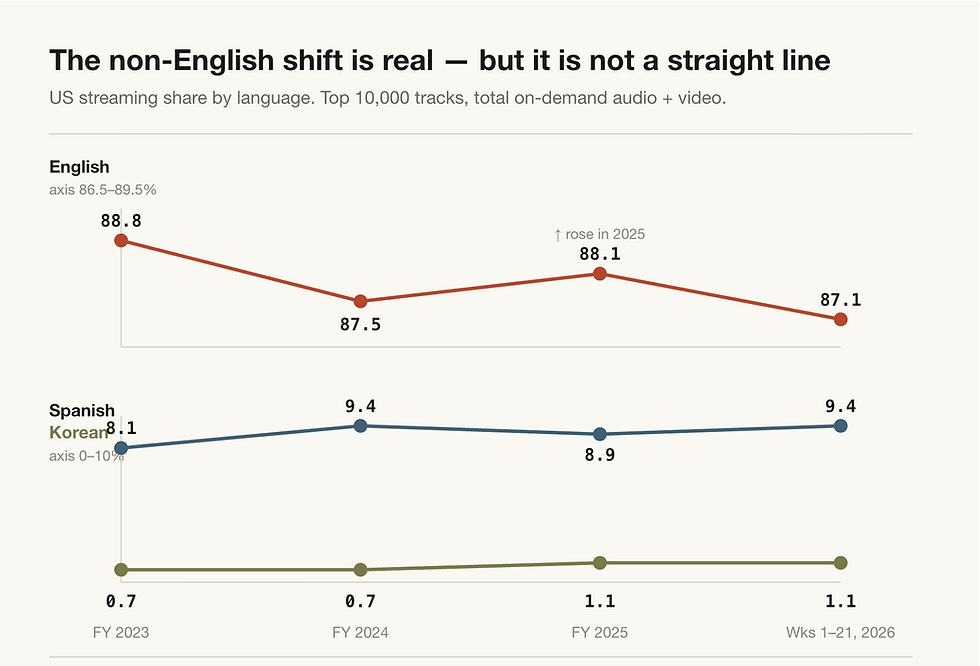
Note what the multi-year series shows that a two-point comparison hides. English share did not decline steadily — it fell, rose again in 2025, then fell to a new low. Spanish moved the same way in reverse. Korean-language share doubled from 0.7% to 1.1% and has since held flat. The structural direction is real; the year-on-year path is not a smooth curve, and any policy argument built on extrapolating a straight line will misforecast.
For ASEAN, this is the load-bearing finding. It removes the last analytical justification for treating "global success" and "westernisation" as the same operation.
The revenue data points the same way. In 2025 every region grew, and the fastest growth was nowhere near the traditional centres: Latin America led at 17.1%, followed by the Middle East and North Africa and Sub-Saharan Africa at 15.2% each, and Asia at 10.9% — against 5.6% in Europe and 3.3% in the United States. Southeast Asian markets specifically grew 9.3%. China overtook Germany to become the fourth-largest market on 20.1% growth, the fastest in the global top twenty.

Governments have already noticed
This is not only a market story. Two states have moved, and they chose different instruments.
France now levies 1.2% on domestic streaming revenue and redistributes it through the Centre national de la musique toward independent labels and artists — a fiscal instrument aimed at where the money settles. It was contested from the start. Announced in December 2023 after a Senate vote, at a rate negotiated down from an initially proposed 1.5–1.75%, it drew opposition from Apple, YouTube and Deezer, and outright retaliation from Spotify, whose French managing director called it a blow to innovation and promptly withdrew the company's sponsorship of the Francofolies de La Rochelle and Printemps de Bourges festivals. The levy is expected to raise around €15 million a year.
Japan took the other route: the industry body CEIPA established Music Awards Japan in 2025, with a second edition in Tokyo in 2026, framed explicitly as elevating domestic repertoire to international standing — an instrument aimed at where legitimacy is conferred. It provoked no comparable fight, for reasons worth thinking about.
Money and recognition. One redistributes revenue, the other confers status. Both are bets that a national music ecosystem is infrastructure worth defending rather than a market outcome to be accepted.
The obvious move for ASEAN is to pick one and copy it. That would be premature, and the rest of this piece is about why: the two instruments rest on preconditions the region does not uniformly have, and they address a problem that the celebrated share statistics do not actually diagnose. We return to what transfers, and what doesn't, further down.
Consumption is not ownership
A chart measures consumption. It records what was played in a given quarter, in which territories, at what volume. It does not measure ownership: who holds the masters, the publishing and the catalogue — the assets that continue to earn long after the quarter closes, and that determine where value settles over a twenty-year horizon.
These are separate questions, and no amount of additional detail about the first will answer the second. Most analysis of the localism turn to date has addressed consumption alone.
The distinction bears directly on how the second half of the IFPI narrative should be read: the growth of local reinvestment, with global majors establishing regional entities and directing capital toward local talent. That phrase covers two very different transactions:
Building local A&R, production, and marketing capacity that a domestically owned company retains.
Acquiring local rights, so that future local success is denominated in offshore-held assets.
Both raise local chart share. Both appear in the same statistic. Only one builds an industry.
This is no longer a hypothetical distinction. IFPI's own 2026 report supplies the worked example, in a chapter devoted to Southeast Asia. Universal Music acquired the RS Music catalogue in Thailand in 2024, a transaction its regional CEO Calvin Wong describes as giving the company the second-largest domestic catalogue in the country. The same interview notes that Universal now works with more than twenty domestic labels across the region.
The implication is worth stating directly. Thai repertoire's rising share of Thai listening is real, and a substantial portion of the Thai back catalogue generating that share is now held by a European-headquartered major. Both are true simultaneously. Consumption has localised; ownership has moved in the opposite direction.
The provenance of this account also merits note. The Southeast Asia chapter of the Global Music Report takes the form of an interview with a major-label executive concerning that label's own investments. This does not call its accuracy into question — the figures are sound and the strategy openly described. It is a point about the limits of what "local reinvestment" reporting can capture. A regional catalogue-ownership register would provide a different view, and none currently exists.
The diagnostic question for any ASEAN cultural ministry or creative agency is therefore not how much of our chart is local? but: if T-Pop, P-Pop, and Indo-Pop double again over the next five years, where does the incremental rent land?
A rights registry answers that question. A chart does not. A market can be 80% locally performed and majority foreign-owned at the same time, and nothing in the currently celebrated data would reveal it.
Height is not depth
There is a second structural measure, largely absent from the localism commentary, that matters more than share for anyone designing industrial policy: how evenly a genre's consumption is distributed across its artist roster.
Luminate's May 2026 analysis of the Korean market is unusually direct on this point. K-pop accounted for roughly half of all streams inside South Korea in 2025 while drawing close to three-quarters of its global streams from foreign listeners — an export ratio most industries would envy. But the same analysis found that just 48 artists generated 39% of K-pop's foreign streams, some 50 billion plays. The comparison Luminate draws is with American R&B/hip-hop, where 112 artists accounted for 36% of foreign streams. Hit concentration is normal in every genre; K-pop's is roughly two and a half times steeper.
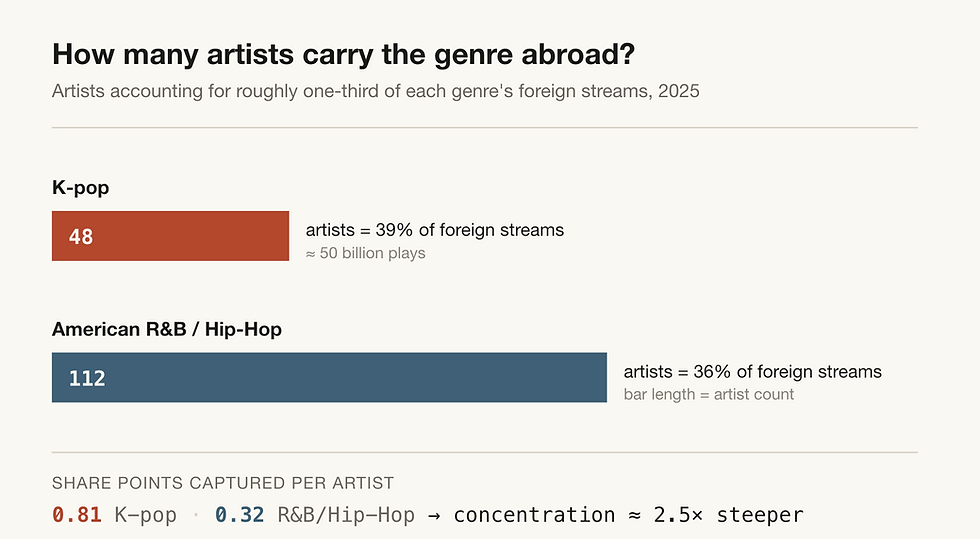
Top-heaviness is a fragility measure, not a failure. It means the genre's international trajectory is coupled to the release calendars, military service schedules, contract renewals, and disbandment cycles of a few dozen acts. A market with a thick mid-tier — artists sustaining careers at 1,000-capacity venues and moderate streaming volumes — absorbs shocks that a top-heavy one transmits directly to national export figures.
The intuitive claim is that ASEAN's local scenes have exactly this depth: many mid-tier acts, broad domestic bases, less dependence on any single name. It is a plausible claim. It is also, at present, an untested one. Luminate's benchmark was drawn against US R&B/hip-hop, not against Indo-Pop, T-Pop, or P-Pop, and no published dataset applies the same concentration methodology to ASEAN repertoire.
Which raises the question Part 2 takes up. The most important comparative statistic for ASEAN cultural policy right now is one nobody in the region has commissioned — and the reason for that gap turns out to be structural rather than accidental.
Coming in Part 2
Two blind spots have been identified so far: the charts do not measure ownership, and they do not measure distribution across the artist roster. Part 2 addresses a third problem of a different order — not what the instrument omits, but who owns the instrument. It covers the Official Southeast Asia Charts and how their design shapes what can be seen; evidence that ASEAN is at least two distinct markets rather than one bloc; what the French and Japanese policy instruments can and cannot transfer; and a regional agenda.
References
Luminate, 2026 Midyear Report (14 July 2026) — US language share by year; market diversity and international-artist share by country; Export Power Rankings.
Luminate, Beyond K-Pop: Preserving South Korea's Musical Future (May 2026) — artist concentration in foreign streams.
Luminate, Beyond English: How the U.S. Music Streaming Market Is Diversifying (Q1 2026) — quarterly language share; Latin listenership.
IFPI, Global Music Report 2026 — State of the Industry (18 March 2026) — global and regional revenue; Southeast Asia chapter; format growth.
IFPI, Official Southeast Asia Charts launch (23 January 2025) and officialseacharts.com — regional chart methodology and governance.
Centre national de la musique — streaming levy design. Contemporaneous reporting on the levy's introduction and the platform response from TechCrunch, IQ Magazine, Music Ally and Euronews (December 2023 – May 2024).
A note on sources
Two numbers in circulation did not survive checking and are not used here. Reports that Korean-language US share peaked at 1.9% before falling appear to be a transcription error; the Luminate table shows it doubling from 0.7% to 1.1% and then holding flat. And the widely shared claim that 39% of K-pop fans report feeling exploited could not be located in any IFPI or Luminate publication.
The Indonesian series showing Indo-Pop rising from 60% to 78% of Spotify Indonesia streams originates with a single independent analyst posting as @tsurezure_lab, who cross-referenced weekly genre data against daily Spotify Top 50 charts across five Southeast Asian markets. It did not come from Spotify, IFPI, Luminate or MIDiA, has not been independently replicated, and the version circulating online is an AI-generated graphic rather than a publisher's visualisation. It is used here only where attributed as such. The reason it circulates so widely is structural: Indonesia falls outside Luminate's comparative plot, so for the largest ASEAN market there is no rigorous alternative to point to. The same analysis reports a −0.79 correlation between K-pop's decline and Indo-Pop's rise, which has been restated elsewhere as cause and effect — but in a share system that sums to 100, two large components moving in opposite directions are arithmetically obliged to correlate negatively. That is a property of the denominator, not evidence of substitution.
IFPI Global Music Report data is subject to the Global Music Report Content Usage Rules (gmr.ifpi.org).